
Brand-Specific Backflow Preventer Repair Guide: Watts, Febco, Wilkins, and Ames
Most backflow repair guidance treats every assembly as functionally identical. In practice, Watts, Febco, Wilkins, and Ames each have distinct internal designs, different kit structures, and specific failure patterns that technicians who work on them regularly recognize on sight. This guide covers what is actually different about each brand — the models you are most likely to encounter, how they are built, how they fail, what kits exist, and the specific notes that prevent the most common brand-specific repair errors.
Why Brand Matters for Repair
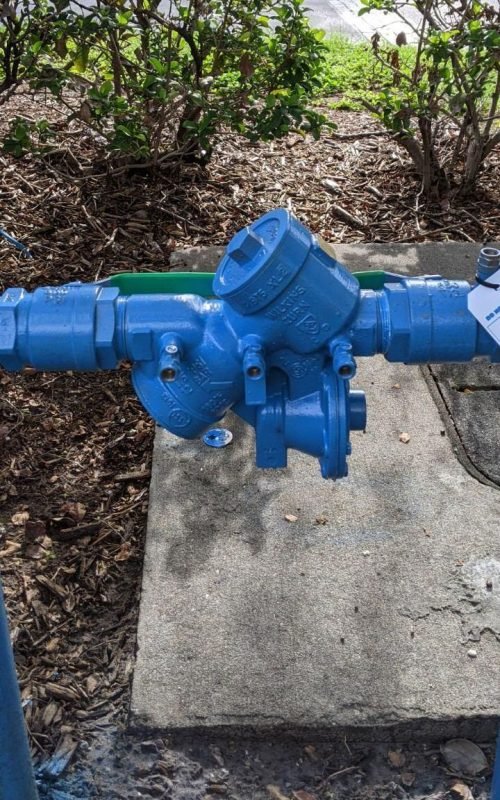
Every approved backflow preventer assembly meets the same performance specifications — ASSE 1013 for RPZ assemblies, ASSE 1015 for double check assemblies, ASSE 1020 for pressure vacuum breakers. What differs between brands is internal architecture: how the check valves are constructed and accessed, whether they use rubber seat discs or O-ring sealed modules, how the relief valve is assembled and removed, what tools (if any) are required for service, and how the rebuild kits are structured and what they include.
These differences matter in practice. A technician who opens a Febco 860 expecting to find rubber seat discs like those in a Watts 007 will find instead that the Febco uses O-ring sealed check modules — and the wrong kit will not work. A technician who tries to rebuild the check valves in an Ames 4000SS stainless-steel RPZ with a rubber goods kit will find that the 4000SS in the 2-1/2″ to 6″ size range has no rubber goods to replace — the cam-check cartridges are replaced as complete units. Understanding the architecture before opening the assembly saves service calls, prevents wrong-parts situations, and produces better outcomes at the first repair attempt.
The four brands covered in this guide — Watts, Febco, Wilkins (now Zurn), and Ames (now Ames Fire & Waterworks, a Watts brand) — account for the large majority of testable backflow assemblies in service in the United States. Apollo, Conbraco, and a handful of other manufacturers round out the installed base; their repair approaches follow the same general framework described here but with brand-specific kits.
Confirm Your Exact Model Before Ordering Any Kit
Watts makes 009, 009M1, 009M2, LF009, and LF009M2 variants that look nearly identical but use different internal components with non-interchangeable kits. Wilkins makes 975, 975XL, and 975XL2 variants where XL and XL2 kits differ for some sizes. Before ordering any rebuild kit, confirm the exact model number from the assembly body stamp — not from a description of what the assembly looks like or where it was installed.
Brand Quick Reference
The following table summarizes the most important repair information for each brand at a glance. Detailed coverage of each brand follows.
| Brand | Most Common Models | Design Signature | Kit Availability | Key Repair Note |
|---|---|---|---|---|
|
Watts |
009 / LF009 (RPZ, 3/4″–2″); 007 / LF007 (DCVA, 3/4″–2″); 800M4 / LF800M4 (DCVA, 3/4″–1″); 009M2 / LF009M2 (RPZ, 2″); 909 (DCVA, large); 719 (DCVA, large) |
Modular check design on 009/007 series; one-cover access on M2 models; bronze body on residential; epoxy-coated cast iron on 2-1/2″ and larger |
Excellent — OEM kits widely stocked at specialty backflow distributors and plumbing supply houses; 009 and 007 kits among the easiest to source nationally |
Original 009 and M-series parts do NOT interchange — confirm exact model suffix (009, 009M1, 009M2) before ordering. LF prefix = lead-free variant introduced 2013. |
|
Febco |
765 (PVB, 3/4″–2″); 825Y / LF825Y (RPZ, 3/4″–2″); 860 / LF860 (DCVA, 3/4″–6″); 850 / LF850 (DCVA, 3/4″–6″); 805Y (SVB, 3/4″–2″) |
O-ring sealed check modules (not rubber seat discs) on 850/860/825Y; sliding cover access on 850/860; bonnet assembly on 765 PVB is field-replaceable as a unit |
Excellent for current models; 765, 825Y, 850, 860 kits widely available; older 775 double check now discontinued with limited parts supply |
Febco design uses O-ring seals rather than rubber seat discs on most check modules — confirm you have the correct O-ring kit, not a generic disc-and-spring kit, before opening the assembly. |
|
Wilkins / Zurn |
975XL / 975XL2 (RPZ, 3/4″–2″); 375 / 375XL (RPZ, 3/4″–2″); 475 (RPZ, 2-1/2″–10″); 720A (PVB, 3/4″–2″); 350 / 350XL (DCVA, 3/4″–2″); 420 / 420XL (PVB, 3/4″–2″) |
Poppet-style check design on 975XL; integral check seat in body (seat not removable without special tool on some sizes); spring-loaded poppets vs. rubber disc style common on other brands |
Good for current XL2 series; original 975 (non-XL) parts now limited — confirm XL vs. XL2 as kits differ; 375 and 475 kits widely available for commercial sizes |
The 975XL and 975XL2 share the same body but use different check internals on some sizes — kits are not fully interchangeable. The RK975TOOL check seat removal tool is recommended for 975XL seat service on 1-1/4″–2″ sizes. |
|
Ames / Ames Fire & Waterworks |
4000B / LF4000B (RPZ, 3/4″–2″); 2000B / LF2000B (DCVA, 3/4″–2″); 4000SS / 5000SS (RPZ, 2-1/2″–10″, stainless steel); 2000SS / 3000SS (DCVA, 2-1/2″–10″, stainless) |
4000B and 2000B closely parallel Watts 009/007 design (shared platform); 4000SS/2000SS Silver Bullet stainless series uses cam-check design unique to Ames with no rubber kit for 2-1/2″–6″ sizes |
Good for current B and LF4000B series; 4000SS cam checks require complete cam check assembly replacement, not a rubber goods rebuild — no rubber kit exists for the SS large-diameter series |
The 4000SS cam check cannot be rebuilt with rubber goods — only complete cam check cartridge replacement. The Watts 994 is a private-label 4000SS. Repair parts are the same regardless of label. |
Watts: The Most Widely Installed Brand in North America
Watts Water Technologies is the largest backflow preventer manufacturer in the United States by installed volume. Their 009 series RPZ and 007 series double check valve assembly are found in virtually every cross-connection control program in the country. Any contractor who specializes in backflow work will have extensive experience with Watts assemblies, and OEM rebuild kits are available from more distributors in more locations than any other brand.
Watts 009 and LF009 — The Most Common RPZ in the Field
The Watts 009 is an RPZ assembly available in 3/4″ to 2″ sizes with a bronze body. The modular check design uses check modules that slide into the body and are secured with a retainer. The relief valve is accessed through the same single cover. No special tools are required for standard service on 009 sizes 3/4″ to 2″.
The original 009 design was introduced in the late 1980s and underwent a significant internal revision beginning with the 009M1 and later 009M2 designations. The “M” suffix models use a one-cover design versus the earlier two-cover design of the original 009. Parts from original 009 assemblies do NOT interchange with M1 or M2 variants — the check modules, retainer clips, and cover O-rings are all different. Confirm the exact model suffix before ordering any kit.
In 2013, Watts introduced the LF009 (lead-free) variant using dezincification-resistant DZR brass and NSF/ANSI 372 certified internal components. Any 009 series assembly installed after 2013 is likely an LF model, and LF rubber kits should be used on LF bodies to maintain material compatibility.
The most common Watts 009 failure pattern is first check fouling by debris — the modular check slides out of the body cleanly for inspection, allowing a quick visual confirmation of whether debris fouling or rubber goods wear is the cause before committing to a full rebuild. This accessibility is one reason the 009 is a favorite among repair technicians: diagnosis and repair can often be completed without removing the assembly from the line.
Watts 009 Repair Kit Types
RK009 (rubber goods only) — seat discs, O-rings, cover O-ring. Does not include springs or check modules. Appropriate when rubber is worn but module hardware is intact.
RK009C (complete kit) — rubber goods plus complete check module replacement. Recommended for assemblies that have not been serviced in several years or when module hardware shows wear.
RK009RV (relief valve only) — relief valve rubber components. For isolated relief valve failures when the checks have been confirmed functional.
RK009SK (spring kit) — replacement springs only. For assemblies where springs have fatigued without accompanying rubber wear.
Watts 007 and LF007 — The Standard DCVA
The Watts 007 double check valve assembly parallels the 009 design in architecture — sliding check modules, single cover access, no special tools required. The LF007 lead-free variant was introduced contemporaneously with the LF009. The same model-suffix caution applies: 007, 007M1, and 007M2 use different kit specifications.
The 007 is the most commonly encountered DCVA on domestic service lines in residential and light commercial applications. It is a frequent irrigation assembly in markets that allow DCVA protection for low-hazard irrigation. Repair kits are among the most widely stocked at plumbing supply houses that serve residential contractors.
Unlike the 009, the 007 has no relief valve, so the test failure modes are limited to first check or second check fouling or wear. Debris fouling of the first check is the predominant failure mode. The modular design allows the check to be removed, inspected, cleaned, and reinstalled in many cases without parts replacement — though replacing the rubber goods as a matter of course during any opening is standard practice.
Watts 800M4 and LF800M4 — Residential Irrigation
The 800M series is a simplified, residential-grade double check valve used heavily on residential irrigation systems. Unlike the 007 modular design, the 800M series uses integral check seats that are not removable as modules. The checks are accessed by removing the body cover, and the rubber disc and spring are replaced individually. A common complaint from technicians on the 800M4 is that the cover bolts corrode in place on assemblies that have been in service for several years without maintenance, making disassembly difficult. Apply penetrating oil to cover bolt threads before attempting removal on an older 800M4.
Freeze damage is more commonly seen on 800M4 assemblies than on the heavier 007/009 series, because many residential 800M4 installations are in above-grade outdoor locations with no freeze protection. An 800M4 that was exposed to a freezing event should be evaluated for body cracks before assuming a repair will hold.
Watts Discontinued Models to Know
The Watts 775 double check valve assembly — a common installation from the 1980s through early 2000s — has been discontinued and manufacturer rebuild kits are no longer produced. Any 775 encountered in the field should be flagged for replacement rather than rebuild. The Watts 900 series backflow assemblies from the same era have similarly limited parts availability; confirm with a backflow specialty distributor before attempting repair.
Febco: O-Ring Modules and Industry-Leading PVB Longevity
Febco has been a major backflow preventer manufacturer since the 1950s and is now part of the Watts family of brands. Their assemblies are characterized by a design philosophy that uses O-ring sealed check modules rather than rubber seat discs for the primary check seal. This produces a distinctively different repair kit structure and a distinctively different failure pattern compared to disc-based designs.
Febco 765 — The Most Common PVB in Irrigation
The Febco 765 pressure vacuum breaker is one of the most widely installed PVB assemblies in the United States, appearing on residential and commercial irrigation systems across all U.S. markets. The 765 has been in production since 1975 with minimal design changes — a testament to the design’s durability and ease of service.
The 765 body is bronze with an integral check seat (non-removable). The bonnet assembly — which contains the air inlet poppet and float — is field-replaceable as a complete unit. Febco offers two bonnet kit sizes for the 765: FE905-047 for 1/2″ to 3/4″ assemblies and FE905-048 for 1″ to 1-1/4″ assemblies. These kits include the complete bonnet, poppet, and O-rings.
The most common Febco 765 failure is bonnet degradation: the air inlet poppet wears to the point where it no longer seals the top vent when the system is pressurized. The 765 will drip continuously from the top of the bonnet. The repair is straightforward — remove the bonnet retaining nut, pull the old bonnet assembly, install the new bonnet kit, reinstall — typically a 15-minute procedure for an experienced technician.
A design change in the 1990s modified the bonnet O-ring thickness on the 765. Rebuild kits from reputable distributors include both the pre-1990s and post-1990s O-ring thicknesses to accommodate both body generations. If a kit you are using does not seal cleanly, confirm whether you have the correct O-ring version for your assembly generation.
Febco 825Y and LF825Y — Commercial RPZ
The Febco 825Y is an RPZ assembly in the 3/4″ to 2″ range and is among the most commonly encountered commercial RPZ assemblies in the western United States. The 825Y uses O-ring sealed check modules that slide into the body, accessed through a sliding cover. The relief valve is a separate field-serviceable assembly.
The O-ring module design means that failure diagnostics on the 825Y look different than on disc-based assemblies. A first check that is fouled with debris may self-clean through a flush procedure. A first check whose O-ring has degraded requires O-ring replacement specifically — a generic disc-and-spring kit from a non-Febco source will not address the sealing surface. Always use Febco-specific O-ring kits (905-series part numbers) on 825Y assemblies.
The Febco 825Y-branded kit structure separates the rubber goods into component-specific kits: a check rubber kit (905-111 for 3/4″ to 1-1/4″, 905-112 for 1-1/2″ to 2″), a relief valve rubber kit (905-043), and a complete rubber kit combining both. For an assembly failing the first check test only, the check rubber kit alone is sufficient. For an assembly with both check and relief valve failures, the complete kit is more efficient.
Febco 860 and LF860 / Febco 850 and LF850 — DCVA Family
The Febco 860 (lead-free: LF860) and its companion 850 are double check valve assemblies available in 1/2″ to 6″ sizes. The 860 is the more current design; the 850 is an older variant that uses a different internal geometry but similar O-ring module principle.
Like the 825Y RPZ, the 850/860 check valves use O-ring sealed modules rather than rubber seat discs. The check module O-ring is the primary sealing element. When a Febco 860 fails its second check test with a declining differential, the cause is almost always O-ring degradation or debris under the O-ring rather than a failed rubber disc. Cleaning the O-ring and seat surface is the first diagnostic step; replacement follows if cleaning does not restore the differential.
Febco 850/860 assemblies in 2-1/2″ and larger sizes have different internal access configurations than the small-diameter versions. Repair manuals for the large-diameter 850/860 are available from Watts/Febco and should be consulted before disassembling a large-diameter assembly for the first time, as the cover and module retention mechanisms differ from the small-diameter design.
Febco Discontinued Models
The Febco 775 double check (not to be confused with the Watts 775 listed above) is another discontinued assembly with limited parts availability. Any Febco model not on the current Watts/Febco product listing should be verified with a specialty distributor before attempting repair. Specialty backflow distributors often maintain secondary-market parts inventory for discontinued assemblies that general plumbing supply houses do not carry.
Wilkins / Zurn: Poppet-Style Checks and the Most Common Commercial RPZ
Wilkins was an independent California-based manufacturer acquired by Zurn Industries and subsequently by Watts Water Technologies. The brand is now marketed as Zurn Wilkins, though assemblies in the field continue to carry the Wilkins name on the body stamp. The 975XL2 is arguably the single most commonly encountered residential and light commercial RPZ in the western and southwestern United States.
Wilkins 975XL and 975XL2 — Understanding the Design Difference
The Wilkins 975XL and 975XL2 occupy the same size range (3/4″ to 2″) and use the same body, but they differ in internal check design in ways that affect kit selection. The original 975XL uses a poppet-style check with a removable check seat that can be replaced separately; the 975XL2 uses a design with the check seat integral to the body, with only the rubber seal ring and poppet serviced through the repair kit.
This distinction matters for parts ordering: RK34-975XL and RK34-975XL2 are different kits with different components. Using the wrong kit will produce parts that either do not fit or do not seal correctly. When in doubt, disassemble the assembly first and compare the exposed check internal geometry to the kit diagram before installing parts.
The 975XL series is known among technicians for the accessibility of its check internals — the poppet-style checks can be inspected and serviced quickly, and the single-cover design means both checks and the relief valve are accessed through one opening. On the 975XL, a special check seat removal tool (part RK975TOOL) is recommended for 1-1/4″ to 2″ sizes to avoid damaging the seat or body threads during removal; smaller sizes can typically be serviced without the tool.
Wilkins 375 and 375XL — The Other Common RPZ
The Wilkins 375 and 375XL are RPZ assemblies widely encountered in commercial and industrial applications, particularly in the 3/4″ to 2″ range. The 375 design predates the XL2 update and uses a disc-and-spring check design rather than the poppet arrangement. Repair kits for the 375 and 375XL are widely available and follow a more conventional rubber goods structure than the poppet-based 975 series. The RK34-375 complete repair kit for 3/4″ to 1″ sizes includes both check seal discs, springs, cover O-rings, and the relief valve components.
Wilkins 720A — The Dominant Residential PVB in the West
The Wilkins 720A pressure vacuum breaker is the dominant residential PVB in western U.S. markets, appearing on the majority of residential irrigation systems installed in California, Arizona, Nevada, and the Pacific Northwest. The 720A canopy assembly (bonnet) is field-replaceable using the Wilkins 721-3 replacement canopy, which is available for 1/2″, 3/4″, and 1″ models. The full RK1-720A complete repair kit includes poppet, canopy, and all associated O-rings.
The 720A canopy assembly is slightly more complex to service than the Febco 765 bonnet — the retaining mechanism uses a canopy nut that requires careful attention to thread engagement. Over-torquing the canopy nut is a common repair error that can crack the canopy or deform the canopy O-ring seat. Follow the torque specification in the Wilkins maintenance manual rather than tightening until it feels solid.
Wilkins Original 975 — Obsolete and Parts-Limited
The original Wilkins 975 (no XL suffix) is an older design that predates the 975XL by many years. Manufacturer repair parts for the original 975 are now described as limited availability — rubber goods only, and only while remaining distributor stock lasts. Any original 975 discovered during an annual test visit should be evaluated for replacement at the next service cycle, not rebuilt repeatedly with increasingly scarce parts.
Ames / Ames Fire & Waterworks: Two Distinct Product Families
Ames Fire & Waterworks (now a Watts brand) produces two architecturally distinct product families: the B-series assemblies (2000B, 4000B) which closely parallel the Watts 007/009 design, and the SS-series Silver Bullet assemblies (2000SS, 4000SS, 5000SS) which use a unique stainless steel cam-check design found nowhere else in the market. Understanding which family a specific Ames assembly belongs to is essential before attempting any repair.
Ames 4000B and LF4000B — The Familiar RPZ
The Ames 4000B and its lead-free variant LF4000B are RPZ assemblies in the 1/2″ to 2″ range. The 4000B design is closely related to the Watts 009 — the companies share design heritage, and technicians familiar with the 009 will find the 4000B very similar to service. The check modules slide out of the body, the cover provides single-point access, and no special tools are required. OEM repair kits use the same kit structure as the Watts 009 (rubber-only, complete, relief valve, spring kits).
The LF4000B was introduced to meet lead-free requirements and uses DZR brass and certified elastomers. Parts from the original 4000B and the LF4000B are not certified as interchangeable — confirm the LF status of the assembly before ordering the LF kit or the non-LF kit.
Ames 2000B and LF2000B — The DCVA Parallel to Watts 007
The Ames 2000B double check valve assembly parallels the Watts 007 in architecture and repair approach. The same kit type structure (rubber-only, complete) applies, and the repair procedure is essentially identical to the 007. The LF2000B uses lead-free certified materials with the same caveats as the 4000B regarding parts compatibility.
Ames 4000SS and 5000SS — The Stainless Steel RPZ with No Rubber Goods
The Ames 4000SS and 5000SS Silver Bullet series represent a fundamentally different approach to backflow assembly design. These assemblies are constructed entirely of stainless steel — body, cover, check hardware, and relief valve housing — making them preferred for corrosive or aggressive water chemistry applications. They are available in 2-1/2″ to 10″ sizes and are common on commercial and industrial fire lines, process water systems, and any application where the usual brass body would face accelerated corrosion.
The critical repair distinction: the cam-check valves in the 4000SS and 5000SS (sizes 2-1/2″ to 6″) cannot be rebuilt with rubber goods. There is no rubber kit. The cam checks are self-contained plastic cartridge assemblies that thread into the stainless body. When a cam check fails — due to debris fouling, wear, or plastic fatigue — the entire cam check assembly is replaced as a unit. The distinction matters because a technician expecting to order a rubber goods kit and find seat discs inside this assembly will be wrong on both counts.
The relief valve on the 4000SS is a separately serviceable stainless steel unit that can be removed from the body by unthreading it. Caution is required during removal: the relief valve body is relatively thin-walled and can be warped or damaged if squeezed by wrench jaws. Use a strap wrench or the appropriate flats on the relief valve body for removal, not plier jaws.
The Watts 994, which some cross-connection control programs have approved and installed, is a private-label version of the Ames 4000SS. The assemblies are identical mechanically, and the same cam check cartridges service both. The Watts 994 designation on the assembly label does not change the repair approach.
The 4000SS Cam Check Is Not a Rubber Rebuild
A technician who has not previously worked on an Ames 4000SS or 5000SS will sometimes open the cover expecting to find the rubber disc and spring arrangement common to most backflow assemblies, and instead find plastic cam-check cartridges. Attempting to disassemble the cam check or substitute rubber goods will damage the assembly. The correct response is to source complete replacement cam check cartridges (Ames part numbers vary by size) from a backflow specialty distributor and replace as units. On the 8″ to 10″ sizes, the cam checks require a specialty cam check tool for safe removal and installation.
How to Identify Your Assembly Brand and Model in the Field
The assembly brand and model number are stamped or cast directly into the body of every approved assembly. On most assemblies, the model number appears on the body between the two shutoff valves, on the body casting adjacent to the test cocks, or on a nameplate bonded to the body. Look for a series of numbers and letters that match the model designations described in this guide.
Key identification details to note when you find the model number: the size (typically expressed as a fraction or decimal, such as 3/4″, 1″, 1-1/2″), whether the model carries a lead-free prefix (LF), and any generation suffix (M1, M2, XL, XL2). The installation date may be stamped separately or indicated by a date code in the casting — though this is not always present on older assemblies.
If the model designation is not legible due to corrosion, paint overspray, or physical damage, photograph the assembly and contact a backflow specialty distributor. Photographs of the body shape, cover design, test cock positions, and shutoff valve style often allow experienced distributors to identify the model and provide correct kit information even without a readable model stamp.
Use Your Brand Knowledge to Prepare Better
When scheduling a backflow repair, telling the contractor the exact assembly brand and model — not just ‘it’s a backflow preventer on my irrigation system’ — allows them to confirm kit availability before arriving, arrive prepared with the correct parts, and provide a more accurate repair quote. For Watts 009, Febco 765, Wilkins 975XL2, and Ames 4000B assemblies, many contractors carry kits on their vehicles because these models are so common. For Febco 825Y, Wilkins 375, Ames 4000SS, and larger commercial sizes, advance parts confirmation reduces the likelihood of a parts-unavailable callback delay. Find certified backflow repair professionals at getyourbackflowtested.com.