
Backflow Preventer Rebuild Kits: How to Choose the Right Kit for Your Assembly
Ordering the wrong rebuild kit wastes money, extends water outages, and can leave an assembly in worse shape than before. This guide explains how rebuild kits are structured, what the different kit types cover, how to identify the correct kit for your specific assembly, and what the OEM versus aftermarket decision actually means in practice.
Why Getting the Kit Right Matters More Than You Think
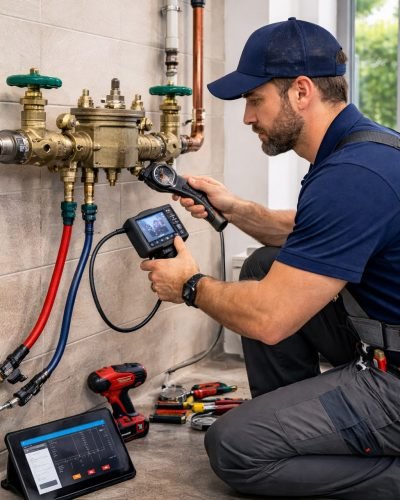
A backflow preventer rebuild kit seems like a simple purchasing decision — find something that fits, buy it, fix the device. In practice, the kit selection process has more variables than most people expect, and errors at this stage cascade through the rest of the repair. The wrong size doesn’t fit. The wrong model variant produces O-rings that are slightly off-dimension and fail to seal. A rubber-goods-only kit ordered for a device with a failing check seat doesn’t address the root cause. An aftermarket kit with non-spec elastomers degrades faster than the original and produces a failure at the next annual test.
The backflow repair parts market is also genuinely complex. Major manufacturers produce dozens of assembly models in multiple sizes, and each model-size combination has its own kit part number. Cross-referencing between brands adds another layer — Ames and Watts share some assembly lineage, and Wilkins kits are now distributed under the Zurn brand, creating part number confusion that trips up even experienced technicians. Understanding how this market is structured is the first step to navigating it confidently.
The Three Kit Types: What Each Covers and When to Use It
Most manufacturers structure their repair parts offering into three tiers. Understanding which tier you need before searching for a part number saves time and prevents incomplete repairs.
Rubber Goods Kit (Most Common)
A rubber goods kit — also called a rubber repair kit or complete rubber kit — replaces all the elastomeric components in one or more check valve chambers: the seat disc, the O-rings that seal the cover and the chamber interior, the diaphragm on relief valve assemblies, and in some kits the springs. This is the appropriate kit for the majority of annual test failures caused by worn seals, chloramine-degraded rubber, or spring fatigue.
When an RPZ assembly fails its annual test with a low differential on one or both checks, and the field test data does not suggest a seat scoring or structural problem, a complete rubber goods kit is the starting point. Replacing all rubber goods simultaneously — rather than only the component that produced the failing reading — prevents a return visit six months later when the adjacent worn components reach their own failure threshold. Most experienced technicians do not replace individual O-rings selectively; they replace the full rubber set for the affected components.
Rubber goods kits are sized by assembly size and model. A 3/4″ Watts 009 rubber kit has different part numbers than a 1″ Watts 009 rubber kit, and both are different from the 1-1/2″ or 2″ versions. Size is the first parameter to confirm before ordering.
Check Module Kit (Component Replacement)
A check module kit replaces the entire check valve assembly as a unit — disc, retainer, seat, and spring come pre-assembled and ready to drop into the check chamber. Some manufacturers have engineered their assemblies around modular check designs specifically to simplify field repair: Febco’s 850 and 860 series, for example, use a check module that slides out as a complete unit and can be replaced in minutes without disassembling the individual components.
Check module kits are appropriate when the seat is damaged rather than just the rubber goods. If a foreign object has scored the check valve seat during a debris intrusion event, replacing the rubber disc on a damaged seat produces a temporary repair that fails again quickly. Replacing the complete check module — which includes the seat as part of the unit — addresses both the seating surface and the elastomeric components in one action.
Module kits are typically more expensive than rubber goods kits because they include the precision-machined seat component. For assemblies with repeated check failures where seat scoring is suspected but not confirmed, the incremental cost of a module kit rather than a rubber kit is usually worth paying.
Relief Valve Kit (RPZ-Specific)
RPZ assemblies have a relief valve in addition to two check valves, and the relief valve has its own repair kit. A relief valve rubber kit replaces the diaphragm, seat disc, and O-rings within the relief valve body. A relief valve total kit or relief valve assembly kit replaces the entire relief valve body as a unit — including the mechanical housing, not just the rubber goods.
A relief valve rubber kit is appropriate when the relief valve is discharging continuously due to a degraded diaphragm or worn seat disc, and the field test confirms the first check is functioning adequately (a properly functioning first check means the intermediate zone pressure is where it should be — if the relief valve is discharging despite a good first check, the relief valve itself is the problem). A relief valve total kit is appropriate when the relief valve body is physically damaged, corroded, or when repeated rubber goods replacements have failed to restore correct opening differential.
Never assume that relief valve discharge means the relief valve kit is what you need. Always perform the field test first. In most cases of continuous relief valve discharge, the first check is the failing component — rebuilding the first check resolves the discharge without touching the relief valve.
The Mechanics: Inside an RPZ Assembly
An RPZ assembly contains five primary components housed within a brass valve body, with two shutoff valves at the inlet and outlet to allow service without cutting the supply line, and four test cocks that provide access points for testing equipment.
First Check Valve
The inlet check valve is a spring-loaded disc that opens under forward flow pressure and closes when that pressure differentiates. It forms the first barrier against backward flow. Under the minimum test standard, this valve must hold a pressure differential of at least 5 PSI — meaning it must resist backflow pressure of at least 5 PSI above the downstream pressure before any water passes through it. In practice, well-maintained first check valves typically hold differentials considerably higher than this minimum.
The Reduced Pressure Zone
Between the two check valves is the reduced pressure zone itself — the internal cavity that gives the assembly its name. Under normal forward-flow conditions, this zone is maintained at a pressure approximately 5 to 10 PSI below the supply pressure. This differential is actively maintained by the relief valve, not passively held by static components. The zone is dynamic, responding continuously to changes in supply pressure and downstream demand.
Differential Pressure Relief Valve
The relief valve is the RPZ’s defining component — the element that makes it fundamentally different from a double check valve assembly. This valve is positioned between the two check valves, vented to the atmosphere through a discharge port. It is held closed by the pressure differential between the supply side and the reduced pressure zone: as long as the zone pressure is at least 2 PSI below supply pressure, the relief valve stays closed.
When that differential drops — because the supply pressure falls, because the first check valve fails to hold, or because backpressure from the downstream side pushes against both check valves — the relief valve opens and discharges water from the reduced pressure zone to the atmosphere. This discharge serves two functions: it prevents the zone pressure from rising to match or exceed supply pressure (which would allow backward flow), and it provides an immediate visible and audible indication that something is wrong.
This is the RPZ’s core advantage over every other testable assembly type: it announces its own failure. A double check valve that begins to fail does so silently, with no external indication until a formal test is performed. A failing RPZ opens its relief valve and tells you there is a problem before contamination can occur.
Second Check Valve
The second check valve provides redundant protection on the downstream side of the reduced pressure zone. Like the first, it is spring-loaded and closes under backpressure. The minimum test standard requires this valve to hold at least 1 PSI differential. Together, the two check valves and the relief valve create a triple-redundant protection system: all three components must fail simultaneously for backflow to occur.
The Most Common Ordering Mistake
Ordering a rubber goods kit for a device whose check seat is scored or physically damaged. The new rubber disc seats against a damaged surface and fails to seal correctly, producing another failed test within a few months. When the field test data shows a check holding zero differential — not just a low reading but zero — inspect the seat before ordering. If the seat is scored, a check module kit is the right choice, not a rubber goods kit.
How to Identify the Correct Kit: A Step-by-Step Process
The correct rebuild kit is defined by four parameters: manufacturer, assembly model, assembly size, and kit type. Confirming all four before placing an order eliminates the most common sourcing errors.
Look for the brand name cast or stamped into the valve body. Common manufacturers include Watts, Febco (now owned by Pentair), Wilkins (now distributed as Zurn by Rexnord/Zurn Industries), Ames, and Apollo/Conbraco. Brand names matter — even assemblies that look identical externally may use different internal dimensions if they come from different manufacturers. Identify the manufacturer.
The model number is typically stamped or cast on the body of the assembly, sometimes on a tag attached to the device. Common model numbers include Watts 009/LF009, Febco 825Y/LF825Y, Wilkins 975XL/LF975XL, Ames 4000SS. If the model number is worn off or missing, the device may have a data plate with the original installation information. A certified tester who has worked in your market will often recognize the model on sight. Identify the model number.
The pipe size the assembly is threaded onto is usually marked on the body — 3/4″, 1″, 1-1/4″, 1-1/2″, 2″, and so on. This is not the same as the body size; it is the connection size. Kit part numbers change with every size increment, and using a kit sized for a 1″ assembly on a 3/4″ device produces parts that do not fit correctly. Confirm the assembly size.
Based on what the field test showed: a low differential on one or both checks points to a rubber goods or check module kit; continuous relief valve discharge with a passing first check differential points to a relief valve rubber kit; a check holding zero differential in a device with a history of debris issues points to a check module kit. When in doubt, the complete rubber goods kit is the conservative choice. Determine the kit type needed.
OEM vs. Aftermarket: Making the Right Call
The OEM versus aftermarket question comes up in virtually every rebuild kit purchasing conversation, and the honest answer is that both have legitimate use cases — but the conditions that favor aftermarket parts are narrower than the marketing for those products suggests.
The Case for OEM Rebuild Kits
Original Equipment Manufacturer kits are produced by the same company that made the assembly and are specified to the same dimensional and material standards as the original parts. The rubber compounds are selected to match the water chemistry performance characteristics that the assembly was designed around. The springs are rated to the same tension specifications as the originals. The O-ring dimensions are exact matches for the grooves they fit into. When an OEM kit is installed correctly, the post-repair test should show differentials close to factory specification — not just barely above minimum threshold.
The other advantage of OEM kits is regulatory clarity. Some water utilities and state programs explicitly require manufacturer-certified parts for repair work performed on assemblies in their cross-connection control programs. Using an OEM kit produces documentation — the kit packaging itself — that confirms compliance with this requirement. Aftermarket kits do not provide this documentation regardless of how their quality compares.
When Aftermarket Parts Are Acceptable
Aftermarket rebuild kits are appropriate in two specific situations. First, when the assembly is approaching the end of its service life and a full replacement is planned within the next one to two years — a temporary rebuild using cost-effective aftermarket parts to achieve compliance for one more testing cycle before replacement is a reasonable economic decision. Second, when OEM parts are unavailable because the model has been discontinued — in this case, aftermarket parts may be the only option, and the alternative is immediate replacement.
The risk with aftermarket parts is material specification variation. Some aftermarket manufacturers produce kits that meet or exceed OEM specifications. Others use rubber compounds with lower chloramine resistance, springs with different tension ratings, or O-rings with dimensional tolerances that produce marginal sealing rather than positive sealing. Without access to the manufacturer’s material specification sheets for the aftermarket kit, there is no way to confirm equivalence from the packaging alone.
Aftermarket kits sourced from known, reputable distributors — established backflow parts suppliers with technical staff who can answer specification questions — carry less risk than generic kits sourced from general plumbing supply houses or online marketplaces without backflow-specific expertise. If choosing aftermarket, buy from a source that specializes in backflow parts and can answer the question: what is the rubber compound durometer and chloramine resistance rating for this kit?
The Amazon Aftermarket Risk
Generic rebuild kits sold through general online marketplaces often describe themselves as meeting or exceeding OEM specifications. Some do. Many don’t. The description ‘meets OEM specification’ is not a verified claim — it’s marketing language that no third party has validated. For assemblies that will remain in service for more than one additional testing cycle, OEM kits from authorized distributors are the appropriate choice. Reserve the generic marketplace kits for emergency situations where OEM parts cannot be sourced quickly enough to meet a compliance deadline.
Brand and Model Reference Guide
The following table summarizes the rebuild kit structure for the most common backflow assembly brands and models found in residential and commercial cross-connection control programs across the United States. Use it as a starting reference, then confirm specific part numbers with your parts distributor or the manufacturer’s current product catalog.
| Brand | Assembly Type | Common Models | OEM Kit Type | Key Kit Contents |
|---|---|---|---|---|
Watts |
Watts |
009, 009M2, LF009 |
Rubber goods kit; first check kit; second check kit; relief valve kit; complete rubber total |
Check disc, O-rings, diaphragm, springs; sold by check number or complete assembly |
Watts |
DCVA |
007, 007M2, LF007 |
Rubber goods kit; check assembly kit |
Two check discs, two springs, cover O-rings; available by check or complete |
Febco |
RPZ |
825Y, LF825Y, 825YA |
Rubber kit (complete); relief valve rubber; individual check poppet assemblies |
Check poppets, relief valve diaphragm, O-rings; also sold as separate RV rubber or check poppet |
Febco |
PVB |
765, LF765 |
Bonnet assembly; poppet assembly; retainer |
Bonnet/poppet set is the primary PVB repair — sold assembled for fast swap |
Febco |
DCVA |
850, LF850, 860 |
Check module kit (either check); rubber kit |
Check module replaces entire check as a unit; rubber-only kit replaces disc and O-ring |
Wilkins / Zurn |
RPZ |
975XL, 975XL2, LF975XL |
Complete rubber kit; check disc kit; relief valve rubber kit |
Check seals, springs, relief valve rubber; RK prefix part numbers (e.g. RK34-975XL) |
Wilkins / Zurn |
DCVA |
350XL, 350, LF350XL |
Rubber kit; pressure vessel repair kit |
Check discs and O-rings; pressure vessel kit addresses body-side seals |
Ames |
RPZ |
4000SS, 2000B |
Rubber goods; first/second check kits; relief valve total kit |
Cross-referenced with Watts 994/774; check modules sold individually or as full rubber set |
Apollo / Conbraco |
RPZ |
40-200, LF40-200 |
Rubber repair kit by size; check module |
Poppet assemblies and O-rings; module-based check design simplifies field replacement |
Special Tool Requirements and Part Sourcing
When You Need More Than Standard Hand Tools
Most backflow assembly rebuilds require only standard hand tools — adjustable wrenches, screwdrivers, and in some cases a torque wrench for cover reinsertion. A few assembly models, however, require special tools that are not commercially available at general plumbing supply houses. These tools are typically designed for a specific disassembly or seat removal operation on a single assembly model.
The Watts 009 and 009M2 series, for example, benefit from a specialized check repair tool (the CheckMate CKM3500) that holds the check seat in position during removal and installation — without it, seat removal risks damaging the body. Febco’s larger commercial assemblies (825Y in 2″ and above) have specific wrench requirements for check cover removal. Before beginning a rebuild on an unfamiliar model, review the manufacturer’s repair manual or contact a backflow parts distributor to confirm whether special tools are required.
Special tools can typically be purchased through backflow-specific parts distributors or directly from the manufacturer. Their cost is usually modest — $30 to $150 for most tools — and they pay for themselves on the first job where they prevent body damage during a check seat removal.
Where to Source OEM Rebuild Kits
The most reliable sources for OEM rebuild kits are specialized backflow parts distributors who stock parts for all major manufacturers and can advise on cross-referencing and model-specific requirements. Major distributors include American Backflow Products Company, Backflow Parts USA, Backflow Supply, Backflow Direct, and regional plumbing and irrigation supply houses that maintain dedicated backflow parts inventory.
Buying directly from the manufacturer’s distribution network is always an option for large orders, but minimum order requirements and lead times make it impractical for single-assembly repairs. A specialized distributor who stocks the full kit range across all brands provides the fastest turnaround for time-sensitive compliance repairs.
When ordering by phone or email, provide the distributor with the manufacturer name, model number, assembly size, and the kit type you need (rubber goods, check module, or relief valve). Ask them to confirm the part number before processing the order. Parts that arrive wrong because of ambiguous ordering can cost days of additional delay in markets where same-day parts delivery is not available.
What to Do When the Right Kit Doesn't Exist
Two situations produce a kit sourcing dead end: the assembly model has been discontinued, or the assembly is old enough that parts are no longer manufactured to the original specification.
Discontinued assemblies are more common than property owners expect. The Watts 775 double check, for example, has been out of production for years and manufacturer parts are no longer available. When a failed assembly is a discontinued model with no available rebuild kit, the path forward is replacement — there is no compliant repair option. This is one of the reasons that working with a knowledgeable parts distributor before authorizing repair work is valuable: they can tell you immediately whether parts exist for a given model.
Assemblies from the 1990s and early 2000s occupy a gray zone — the manufacturer may still produce some parts but not the complete rubber goods kit, forcing a component-by-component sourcing approach that requires detailed knowledge of the internal part specifications. A backflow technician with deep experience in a specific geographic market will know which older assemblies are still supportable with parts and which are effectively unrepairable. If you are working with a new contractor on an older assembly, asking specifically about parts availability for your model before authorizing repair is a reasonable due diligence step.
Confirm Lead-Free Compliance Before Ordering
Since January 1, 2014, federal law requires that any plumbing component installed in contact with potable water be lead-free (weighted average lead content ≤ 0.25%). Most OEM rebuild kits produced after 2012 are certified lead-free, but some older new-old-stock inventory and aftermarket kits are not. When ordering, confirm with the distributor that the kit is certified lead-free. If your water utility or state program explicitly requires lead-free parts documentation, request the certification with the kit. Using non-certified parts in a potable water application is a compliance violation regardless of whether it produces a passing test result.
Putting It Together: A Pre-Repair Checklist
Before starting any backflow assembly rebuild, confirm the following:
Manufacturer and model number verified from the device body — not from memory or a previous report.
Assembly size confirmed — the connection size as marked on the body, not estimated from the pipe.
Field test data reviewed and root cause identified — rubber goods issue, seat issue, or relief valve issue.
Correct kit type selected for the identified root cause — rubber goods, check module, or relief valve kit.
OEM vs. aftermarket decision made deliberately, not by default.
Lead-free certification confirmed for the selected kit.
Parts availability verified before scheduling the repair visit — ordering confirmation in hand, not assumed.
Special tools identified and confirmed on hand for the specific model.
Post-repair retest scheduled or confirmed that the repair technician will perform it in the same visit.
A rebuild performed with the right kit, installed by a qualified technician, verified by a proper post-repair test, and documented with a filed test report closes the compliance record efficiently and restores the assembly to years of reliable service. The kit selection process is where that chain of success begins.
Find a Certified Backflow Repair Technician
Sourcing the right rebuild kit is only part of the repair equation. The technician performing the rebuild must be qualified to install it correctly and perform a certified post-repair test. The tester and repairer directory at getyourbackflowtested.com lists certified professionals by state who hold both backflow tester certification and the qualifications needed to perform compliant repairs.