
Backflow Preventer Leaking: How to Diagnose Where It's Coming From and What Fixes It
Not all backflow preventer leaks are the same problem. Water from the relief port, the test cock, the bonnet vent, the body seam, the shutoff stem, and the pipe union each have different causes and require completely different responses. This guide tells you exactly where to look, what each leak location means, and what actually fixes each one.
Start Here: Locate the Leak Before You Diagnose It
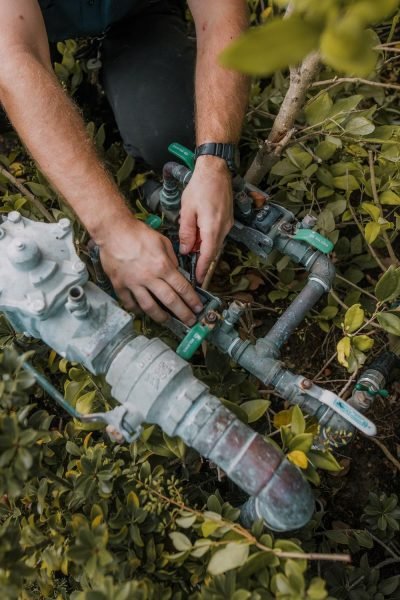
The most important step in diagnosing a leaking backflow preventer is not identifying the cause — it is identifying the location. Different parts of a backflow assembly leak for completely different reasons. Water dripping from the side of an RPZ assembly means something entirely different than water dripping from the top of a PVB bonnet, which means something entirely different than water seeping from a threaded union fitting. Confusing leak locations leads directly to wrong repairs: replacing a rubber goods kit in an assembly whose actual leak is coming from a worn test cock O-ring, or scheduling an internal rebuild on an assembly whose actual problem is a loose packing nut on the shutoff valve.
Before calling anyone or ordering any parts, take two minutes to observe and photograph the leak. Take note of exactly where the water is exiting — which specific part of the assembly, and from which side or surface. Wipe the assembly dry with a cloth and watch for thirty seconds to confirm where new moisture appears first. This observation is the foundation of an accurate diagnosis.
A second key observation: note the character of the leak. Is it continuous, or intermittent? Does it correlate with any system activity — irrigation zones running, water heater cycling, fixtures being used? Does it change in volume when you close one of the shutoff valves? These behavioral observations narrow the diagnosis further, particularly for RPZ assemblies where different leak sources produce different behavioral patterns.
The Single Most Useful Diagnostic Action
Before doing anything else with a leaking backflow preventer, close the downstream shutoff valve (the number two shutoff on the outlet side of the assembly) and observe whether the leak changes or stops. If closing the downstream shutoff stops or significantly reduces an RPZ relief valve discharge, a downstream pressure condition — second check failure or thermal expansion — is likely involved. If the leak continues unchanged regardless of shutoff position, the first check or the relief valve itself is the source. This one observation eliminates half the possible causes.
Leak Location Diagnostic Reference
The following table maps every common backflow assembly leak location to its most likely cause and the correct response. Use it as a first reference when you identify where the water is coming from.
| Leak Location | What It Looks Like | Most Likely Cause | Correct Response |
|---|---|---|---|
RPZ Relief valve port (side discharge, pointing down) |
Water dripping or streaming from the center discharge port on the underside of the assembly body |
First check valve not sealing — debris on seat or worn disc (90% of cases). Less commonly: second check failure from backpressure, or relief valve diaphragm degraded. |
Do NOT block the port. Perform or schedule a certified field test immediately. If continuous and steady, this is a compliance failure requiring repair within your jurisdiction’s deadline. |
PVB bonnet vent (top opening) |
Water dripping or seeping from the vented opening at the top of the PVB bonnet, especially during pressurized operation |
Bonnet poppet assembly degraded — air inlet not sealing fully under pressure. May also be freeze damage to the bonnet housing if occurred after a cold event. |
Schedule bonnet/poppet rebuild using OEM kit. If bonnet housing is cracked (visible crack or deformation), the bonnet cannot be rebuilt — replace the assembly. |
Test cock fitting (small side ports with screw slots) |
Drip or weep from one or more of the small side ports on the assembly body. May be from the screw fitting itself or from the cap/plug that covers it. |
Test cock left slightly open after last annual test (screw not returned fully to closed position), or test cock O-ring degraded and no longer sealing around the fitting body. |
First confirm the screw is fully closed (perpendicular to the pipe). If dripping continues with screw closed, the test cock O-ring needs replacement. Full test cock replacement may be needed for corroded or damaged fittings. |
Shutoff valve stem (at the handle/stem area) |
Dripping from around the stem or handle of one of the ball valve shutoffs, often visible as moisture around the base of the handle |
Packing nut has worked loose from vibration or thermal cycling, or the valve stem packing is worn and no longer providing a seal around the rotating stem. |
Attempt gentle snugging of the packing nut (quarter turn maximum). If dripping continues or worsens, the shutoff valve requires replacement by a licensed plumber — this is not a rubber goods repair. |
Body-to-cover joint (bonnet seam on PVB; check cover joint on RPZ/DCVA) |
Moisture seeping from the seam between the body and the check valve access cover, or between the bonnet and the PVB body |
Cover O-ring degraded or improperly seated. May also be a result of over-torquing the cover during a previous service, which damaged the O-ring groove or cracked the cover. |
Schedule rubber goods service — the cover O-ring is typically included in rebuild kits. If the cover itself is cracked or the O-ring groove is damaged, the cover must be replaced. |
Pipe union connection (threaded connections at supply or outlet side) |
Dripping or weeping from the threaded union fittings where the assembly connects to the supply and distribution piping |
Union gasket or O-ring dried out or compressed beyond service life. Common after years of thermal cycling, or after the union was disconnected and reassembled without replacing the gasket. |
Close supply shutoff, open union, inspect and replace the union gasket or O-ring. Apply thread sealant appropriate for potable water on threaded connections. Have a licensed plumber perform if not comfortable with pressurized fitting work. |
Body crack (anywhere on the valve body) |
Water seeping, dripping, or streaming from a visible crack in the brass body — often a hairline crack along a seam, around the relief port, or at the bonnet bolt holes |
Freeze damage from water expansion inside the body cavity. Physical impact. Dezincification weakening the structural integrity of the brass body. |
Close supply shutoff immediately. Body cracks cannot be repaired. Full assembly replacement required. Investigate and address freeze protection or dezincification cause before replacement. |
Wet soil or pooling around assembly (no visible external source) |
Ground consistently wet around the assembly; water pooling in a valve box that drains otherwise; algae or mineral staining on nearby concrete without an obvious drip location |
Underground pipe connection leak, or a relief valve discharge that drains underground before becoming visible. May also be a slow crack on the underside of the body not visible without removing the assembly. |
Have a certified technician inspect both the above-grade assembly and the underground connections. Relief valve discharge lines that terminate underground without an air gap are a code violation in most jurisdictions and must be corrected. |
The RPZ Relief Port: The Most Commonly Mishandled Leak
The relief valve discharge port on an RPZ assembly is the single most common location from which property owners report a leak — and also the most frequently mishandled. Two wrong responses are extremely common: blocking the port to stop the visible water, and assuming the relief valve itself has failed and needs replacement.
Never Block the Relief Port
The relief valve discharge port must remain open and freely draining at all times. It is an intentional opening designed to discharge water to atmosphere when the internal pressure relationship is compromised. Blocking it — with tape, a cap, a plug, or anything else — removes the assembly’s fail-safe mechanism. If both check valves are degraded and the relief valve cannot discharge, there is no longer any barrier between the contaminated downstream water and the supply. Beyond the safety consequence, a capped relief port typically violates local plumbing code, which requires the discharge to terminate with a visible air gap to an open drain.
The reason people block it is understandable: the water discharge is causing pooling, staining, or flooding around the assembly. The correct response to a problem with discharge drainage is to route the drainage properly — to an approved floor drain, an open channel, or a proper air gap fitting — not to prevent the relief valve from doing its job.
Don't Replace the Relief Valve Without Testing First
The second common error is assuming that a discharging relief valve means the relief valve itself has failed. As covered in detail in the companion article on relief valve discharge, continuous relief valve discharge in an RPZ assembly is caused by the first check valve in roughly 90 percent of cases. The first check not sealing adequately allows supply pressure to bleed into the intermediate zone, eventually raising zone pressure to the point where the relief valve opens.
Replacing the relief valve rubber kit without first testing the first check differential is treating the most visible symptom rather than the root cause. After replacement, the new relief valve will begin discharging again within days because the first check problem has not been addressed. The correct sequence is always: perform the field test first, identify which component has degraded, then repair the identified component.
Test Cock Leaks: The Smallest Leak and the Easiest to Misread
Test cocks are the small side ports on the assembly body that provide connection points for the tester’s calibrated gauges during annual testing. They consist of a body that is threaded into the assembly, an internal screw or plug that controls flow through the port, and a cap or plug that protects the port between testing events.
The First Thing to Check: Is the Screw Fully Closed?
After every annual test, the tester is required to return all test cock screws to the fully closed position. This sounds simple, but test cocks left slightly open — even a fraction of a turn — will drip continuously under operating pressure. If a test cock is leaking and you observe water immediately after an annual test visit, this is the most likely cause. Use a flat-head screwdriver to gently turn the test cock screw clockwise until it stops. Do not apply significant force; the screw should close easily. If the drip stops, the problem was an insufficiently closed test cock screw.
Test Cock O-Ring Replacement
If the test cock screw is confirmed fully closed and water continues to seep from around the body of the fitting — not from the screw slot but from the fitting itself where it threads into the assembly body — the test cock O-ring has degraded. The O-ring sits in a groove around the test cock body and seals it against the assembly body. When this O-ring dries out, cracks, or compresses beyond its sealing range, water seeps around the fitting threads under operating pressure.
Test cock O-ring replacement is a minor repair. In some assemblies, the test cock O-ring is included in the standard rubber goods rebuild kit. In others, it is a separately available part. The test cock is unscrewed from the assembly body (with supply shutoff first), the old O-ring is removed, a new O-ring is installed and lightly lubricated with an appropriate synthetic lubricant, and the test cock is reinstalled and snugged. Some assemblies have test cocks that are not field-serviceable and must be replaced as a complete unit when they fail.
Corroded or Physically Damaged Test Cocks
Test cocks that have been exposed to years of mineral scale buildup, harsh chemical environments, or mechanical stress can corrode to the point where the fitting body itself is compromised — not just the O-ring. A corroded test cock that weeps from multiple points around its body, or one whose threads have degraded to the point where it cannot be tightened securely, must be replaced as a unit. Test cock replacement is a licensed plumber task in most jurisdictions.
Shutoff Valve Stem Leaks: Not an Assembly Problem
A drip from around the stem or handle base of one of the shutoff valves on a backflow assembly is not a problem with the assembly itself — it is a problem with the shutoff valve. This distinction matters because the repair approach is completely different: repairing the backflow assembly’s internal components does nothing for a leaking shutoff valve stem.
The Packing Nut Approach
Shutoff ball valves have a packing nut — a threaded fitting that compresses the stem packing material and creates a seal around the rotating valve stem. Over time, vibration, thermal cycling, and normal mechanical wear can loosen the packing nut, allowing water to seep past the packing and up around the stem. A gentle quarter-turn clockwise on the packing nut — using a wrench sized to the nut — often stops this drip. Do not apply more than a quarter turn without reassessing; overtightening makes the valve difficult to operate and can damage the packing.
If tightening the packing nut does not stop the drip, or if the nut was already at its adjustment limit, the packing material itself is worn and needs replacement. In most cases at this stage, replacement of the shutoff valve is more practical than repacking it — particularly for smaller residential assemblies where the labor cost of repacking approaches the cost of a new valve.
When Shutoff Valve Replacement Is the Only Option
A shutoff valve that drips after packing nut adjustment, a valve whose stem is corroded and will not rotate freely, or a valve whose internal seat has degraded to the point where it will not hold fully closed during testing all require full valve replacement. Shutoff valve replacement requires cutting into the supply piping and is a licensed plumber task. It is also a compliance task: the replacement valve on a backflow assembly must be a tapped ball valve — one with a test cock port — to allow proper testing. Standard ball valves without test cock ports are not acceptable replacements.
Body Seam and Cover Joint Leaks: O-Ring vs. Structural Damage
Water seeping from the joint between the assembly body and a check valve access cover (on RPZ or DCVA assemblies), or from the joint between a PVB bonnet and the body, can result from two very different problems with very different responses.
Cover O-Ring Failure
The access covers on check valve chambers are sealed against the body with an O-ring that sits in a groove around the cover face. When this O-ring dries out, swells from chloramine exposure, or is damaged during a previous service visit — particularly if it was pinched during reassembly — water seeps through the seam under operating pressure. This leak is repairable: the cover O-ring is typically included in the assembly’s standard rubber goods rebuild kit. The cover is removed, the old O-ring is discarded, the groove is inspected for debris or damage, and a new O-ring is installed and lubricated before the cover is reinstalled at the correct torque.
Over-tightening a check valve cover is a common repair error that creates exactly this problem. If a cover is forced beyond the correct torque — attempting to stop a seam drip by tightening further, rather than addressing the O-ring — the O-ring can be permanently deformed, the cover can crack, or the O-ring groove in the body can be damaged. Covers should be tightened to the manufacturer’s specified torque range, then checked for seam dryness after pressurization. If the seam is still wet at the specified torque, the cover must be removed and the O-ring inspected.
Body Crack
A body crack is a structural failure, not a sealing failure. The visual distinction: a seam leak from a degraded O-ring produces moisture evenly around the circumference of the cover joint. A body crack produces water from a specific linear point — a visible line in the brass, often radiating from a stress concentration point like a bolt hole, the relief valve port area, or a threaded connection.
Body cracks require full assembly replacement. There is no repair for a cracked valve body. Close the upstream shutoff immediately when a body crack is confirmed — a cracked body will fail completely under operating pressure, potentially producing a sudden and significant water release at the installation site. Investigate the cause (freeze event, physical impact, dezincification) and address it before the replacement assembly is installed.
PVB Bonnet Vent Leaks: Normal Operation vs. Degraded Components
The pressure vacuum breaker has an atmospheric vent at the top of the bonnet assembly that intentionally opens to atmosphere when the PVB is not under supply pressure — this is what allows it to function as a vacuum breaker. This means the PVB’s behavior near the top of the bonnet requires some interpretation to distinguish normal operation from failure.
When to Start PlanWhat Is Normal for a PVB Bonnetning
A brief discharge from the bonnet vent when the irrigation system first pressurizes, or when an irrigation zone opens and flow begins, is normal. The PVB is transitioning from its depressurized state (vent open, air entering) to its pressurized state (vent sealed by the poppet). This transition produces a momentary release of water at the vent that stops as soon as the assembly reaches operating pressure. If the discharge stops within a few seconds of pressurization, the PVB is functioning normally.
When Bonnet Drip Is a Problem
A PVB bonnet that drips continuously during pressurized operation — with the irrigation system running and the assembly under supply pressure — indicates that the air inlet poppet is not sealing the vent closed when it should. The poppet assembly inside the bonnet relies on supply pressure acting against a rubber-tipped or rubber-faced disc to seal the air inlet. When the disc wears, hardens, or is held partially open by debris, the vent does not seal, and water drips from the top of the assembly during pressurized operation.
This is a repairable condition using a bonnet/poppet rebuild kit. Many experienced contractors carry these kits preassembled for the most common residential PVB models and can perform a same-visit replacement during an annual test call. The old bonnet assembly is removed by unscrewing the retaining nut, the internal components are replaced, and the bonnet is reinstalled.
A PVB bonnet that shows a visible crack — often at the base of the bonnet housing where it connects to the body, or along the side of the bonnet cap — cannot be rebuilt. The cracked housing must be replaced. Many PVB manufacturers offer replacement bonnet housing kits; in some cases where the crack indicates general body degradation, full assembly replacement is more appropriate.
Pipe Union and Threaded Connection Leaks
Backflow assemblies connect to the supply and distribution piping through threaded or union connections. Leaks at these connections are pipe-fitting problems, not assembly problems — but they are located adjacent to the assembly and are often misattributed to the assembly itself.
Union Gasket Failure
Union connections have a rubber or fiber gasket that creates a watertight seal between the two union halves. These gaskets are under continuous compression from the union nut, and they degrade over time through drying, mineral impregnation, and thermal cycling. A weeping union — one that drips from the seam where the two union halves meet — typically requires only gasket replacement. Close the supply shutoff, disconnect the union, replace the gasket with one of the appropriate size and material for potable water, and reassemble. If the union threads are corroded or the union has been over-tightened to the point where the threads are damaged, the entire union fitting must be replaced.
Threaded Connection Failure
A leak at a threaded connection between the assembly and the adjacent piping — where the assembly threads onto a nipple or coupling — can result from degraded thread sealant, corroded threads, or cross-threading during a previous installation or service visit. Repair requires removing the assembly from the connection, inspecting the threads on both the assembly and the mating fitting, and reinstalling with fresh potable-water-rated thread sealant (PTFE tape plus pipe dope, or a one-component potable-approved pipe sealant). Badly corroded or damaged threads require replacement of the affected fitting.
The Hidden Leak: Wet Soil Around the Assembly
A patch of ground that stays wet around a below-grade backflow assembly, or consistent water pooling in a valve box that otherwise drains properly, often indicates one of two things: a relief valve discharge line that terminates underground without an air gap (a code violation), or a slow body crack or fitting leak on the underside of the assembly that is not visible without removing the assembly from its vault. Neither of these is diagnosable from above-ground observation alone. If the above-grade portions of the assembly appear dry but the surrounding soil or vault remains wet, schedule a technician inspection that includes assessment of the underground connections and the relief valve drain routing.
What You Can Assess Yourself vs. What Requires a Certified Technician
Understanding where the boundary falls between safe property owner observation and work that requires a certified technician or licensed plumber protects both the assembly and compliance status.
Safe Property Owner Actions
Observe and photograph the leak location — taking note of exactly where water is exiting and whether the discharge is continuous or intermittent.
Close the downstream shutoff valve and observe — this is the first diagnostic step for any RPZ relief valve discharge and requires no special tools or training.
Confirm test cock screws are fully closed — if an annual test was recently performed, this is the first thing to check for any test cock drip.
Attempt gentle packing nut snugging — a quarter turn on a dripping shutoff valve packing nut is within the range of safe property owner action.
Note all relevant context — recent freeze events, nearby main break or hydrant flushing, water heater cycling, or recent changes to the irrigation system help the technician narrow the diagnosis faster.
Requires a Certified Technician or Licensed Plumber
Any disassembly of the assembly body — opening check valve covers, removing test cocks from their sockets, or removing any component from the assembly body constitutes a repair in most jurisdictions and must be performed by a person with appropriate credentials.
Any work that affects the compliance status — all repair work must be followed by a certified post-repair test and a filed test report. Property owners who perform their own repairs typically cannot perform the required certified retest.
Shutoff valve replacement — requires cutting into the supply piping and installing a tapped ball valve; licensed plumber work in virtually all jurisdictions.
Full assembly replacement — requires a plumbing permit in most jurisdictions and must be followed by an initial compliance test.
Photograph Before You Call
Before calling a repair technician, take several photographs of the leak — one showing the full assembly with context, one close-up showing exactly where the water is exiting, and one showing the area below the assembly (pooling, staining, or wet soil). These photographs allow the technician to assess the likely cause, estimate the repair scope, and confirm they have the appropriate parts before arriving — reducing both diagnostic time and parts-ordering delays. Find certified backflow repair professionals by state at getyourbackflowtested.com.